
The definition of ‘substrate’ is; ‘a substance or layer that underlies something, or on which some process occurs’. Therefore the term substrate can include any material that makes up the base layer of the aquascape, and this can include gravels, sands etc. In recent times, specifically made products have come onto the marketplace from well-known manufacturers which are designed specifically to encourage plant growth. To keep this article concise we will mainly cover two of the most effective kinds of substrate available today; Complete substrate – this may simply be poured into the aquarium and is ready to plant and Compound substrate – this needs ‘capping’.
Why are substrates used?
- As a natural decorative layer
- An anchor point for roots
- A means of storing and supplying vital minerals and nutrients, and
- A home for beneficial bacteria
These beneficial, colonising bacteria will also help in breaking down fish and plant waste and excess food, turning them into nitrates that the plants will feed on. Where a successful substrate system is used these actions will take place at an optimum rate, compaction will be minimised and a slow movement of nutrient rich water will be created throughout the aquarium bed. This will help prevent the build-up of pockets of hydrogen sulphide which may be harmful to fish and plants. We use substrates that are able to draw nutrients from the water column, effectively recharging the substrate layer. This gives them great longevity.
How to use a complete substrate
There are several complete substrates on the market today. Our current product of choice is ADA Aqua Soil, which can simply be poured into the tank and planted into. It also has an ammonia spike in the first two to three weeks of use, which acts as food for colonising filter bacteria. This will mature the filter prior to the addition of livestock and is an easy method of what has become known as ‘fish-less’ cycling of the filter. ADA Aqua Soil is now even better value in the UK with new lower prices. There are some products on the market which try to imitate the look of ADA Aqua Soil, but looks can be deceptive, you can find out how in ADA’s comparison article here.
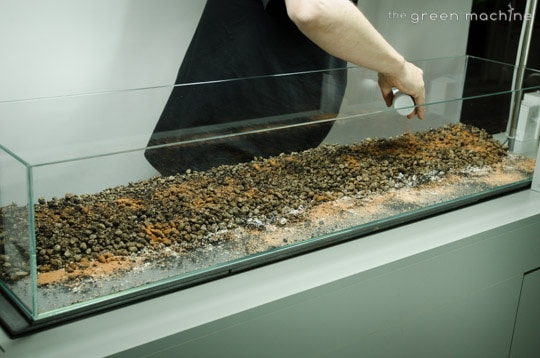
ADA Aquasoil may be used as a standalone product, or for even better results it can be combined with a base layer that acts as a biological filter. We use ADA Power Sand for this and have achieved outstanding results.
ADA Power Sand is a volcanic pumice available in various sizes; small, medium and large, depending on the tank size. It is porous and provides the perfect home for beneficial bacteria, effectively turning the whole substrate into a form of biological filtration. It will also stop compaction and encourage water movement within the substrate helping to keep it fresh. It may be used in conjunction with other makes of substrate.
How to use a compound substrate
Excellent results can also be achieved using a compound substrate, like Tropica. Usage is slightly different from a complete substrate in that a one-centimetre thick layer of the substrate is placed over the base of the aquarium, and may be made slightly deeper towards the back of the aquarium. This is then covered with a layer of fine two to five millimetres (grain size) lime free gravel which will effectively ‘cap’ the substrate and prevent it clouding the water column. This substrate should be covered with at least three centimetres of gravel to effectively separate it from the water to prevent clouding. A five to ten centimetre wide strip along the front of the tank may be left substrate free so that a slightly shallower level of gravel may be used here for aesthetic purposes.
Heating cables- don’t bother!
Experiments have been carried out with under-gravel heating cables by us and others as it has been claimed that they benefit plant growth by causing the convection of water and nutrients from the substrate. We have found that the use of these cables has had no significant benefit and none of our in-store displays feature under-gravel heating. We do not advocate their use.
Set-up
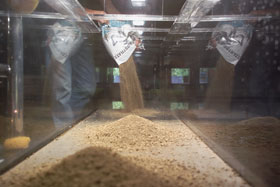 In aquascaping, substrate is normally added to an aquarium so that it will be thicker towards the back of the tank. This may be 40cm plus at the rear sloping down to only five-centimetres or so of decorative sand at the front. This adds visual interest and increases the surface area of the base of the aquarium, allowing more space for planting. (Bolbitis, Anubias and Microsorum do not necessarily need a substrate and may grow better when attached to wood or stone.
Others such as Nymphaea and Aponogeton will produce a very large root system and species such as Cryptocoryne and Echinodorus are deep rooted and will fare better with a deeper substrate base. Planting these in a very shallow substrate would be the equivalent of us wearing shoes that were too small; growth of some plants may suffer when substrate is too shallow.
Plants such as Hygrophila and Rotala have long stems but fairly shallow roots and will manage well in shallower areas.
Substrate Additives
As an addition to the substrate layer, there are several additives which are designed to help planted aquariums in various ways. This section will be updated in future, please come back in the future for more info.
Decorative gravels
 Strictly speaking, gravel is a substrate, but we would not recommend using gravel alone in a planted tank. It is, however, very useful when used to cap a compound substrate or various sizes of graded gravels may be used as a final cosmetic layer to create a more natural effect.
In nature, materials are deposited on river beds according to their size and weight and the energy of the flowing water. The result is a natural spreading (or grading) of materials by their size. In an aquarium a very natural looking effect may be achieved by using several gravels of various sizes with the final use of coarse sand if required.
Larger gravels (two-centimetres +) should be placed near the main rock structures, decreasing in size down to coarse sand at the edges of the aquascape. Careful use of this technique will create the most natural looking artworks and is effective in creating a true Nature Aquarium style.
Maintenance
A good quality substrate should need very little maintenance; gentle vacuuming once weekly will remove surplus detritus from the planted areas and gentle raking of the sand will ensure that this stays looking fresh and clean.
Conclusion
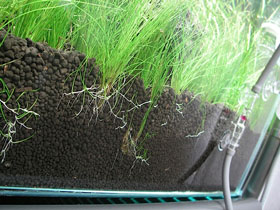
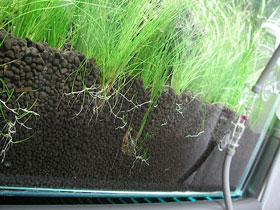
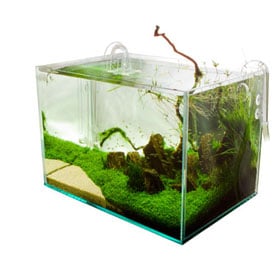
There are some who say that simply dosing the water column is adequate fertilasation. Our own experience is different to this and is indicated by the results achieved. There can be no doubting the positive effects on plant growth when a good quality base layer is used ensuring that the bottom of the tank is evenly covered. The effects of root growth into the substrate may be seen here.
Like this article? Read more like this…
- ADA’s Substrate Article – Characteristics of Substrate Materials Unperceivable Just by Their Appearance
- Building up height in Substrate
- How to Rejuvenate Old Substrate without Re-Planting
- Nature Aquarium Cabinet Guide – Find your perfect aquarium stand!
- Summer Time is Wabi-Kusa Time….get your Wabi on!
- Aquascaping: A Whole New Dimension
- How to Make Your Planted Tank Sparkle for a special occasion!
- The Power of ADA: A History of Takashi Amano and ADA
- The Power of ADA: The Philosophy of ADA
- The Story of ADA Super Jet Filters: A Note from Takashi Amano
- + Many more! – Explore our website!
Can you tell more about the experiments with the heating cables?
How long did the experiment last? A few months or 10 year?